From lime or calcined wine lees
Strasbourg Manuscript: lye from calcined wine lees (Neven 170) who quotes Colmarer Kunstbuch.
Alchemy of Paint
Bucklow (28-29, 48, 61-64, 69,75,109, 200)
First Lye post with personal references
Showing posts with label De Arte Illuminandi. Show all posts
Showing posts with label De Arte Illuminandi. Show all posts
Monday, July 9, 2018

Friday, April 6, 2018
'vergaut'? Blue and yellow make green!
The
term 'vergaut' was introduced to me by Elena Wyth when she asked a
question about mixing indigo and orpiment on Facebook. I hadn't come across it
before, so I went to the books!
There seem to be many medieval instructions for mixing orpiment and indigo but few call it vergaut, as far as I can see. Read more below to see what a brief search helped me find.
There seem to be many medieval instructions for mixing orpiment and indigo but few call it vergaut, as far as I can see. Read more below to see what a brief search helped me find.
Tuesday, October 4, 2016
Iris Green 2016
Last year for my pigment experiments I used aluminum sulfate from a dye company thinking that was the right kind of alum. In 2016 I made Iris green clothlets with the medievally recommended alum, Rock Alum, which I learned is aluminum potassium sulfate or potassium aluminum sulfate, KAl(SO4)2·12H2O.
 |
| Iris Green Clothlets 2016 from De Arte Illuminandi |
Click "read more" below to find out how!
Friday, September 16, 2016
Buckthorn yellow 2016
This year I decided to try using concepts from De Arte Illuminandi to try unripe, green berries to make yellow, a possibility indicated by the translators.
That page of Merrifield's text explains,
and the result is reinforced by the Pigment Compendium that explains,
Here's a preview picture of them,
And now I'll explain how I made them, just click 'read more' below.
Two pigments were and are derived from Rhamnus berries; a yellow and a green. The product of the unripe berries is the Giallo santo (cf. M. P. Merrifield, op cit., I clxiv), known in English by the extraordinary names, "Italian Pink" and "Dutch Pink."(Thompson and Hamilton 43)
That page of Merrifield's text explains,
Giallo santo was a kind of yellow lake, which was made from various plants. It was sometimes prepared from the berries of buckthorn (Merrifield clxiv)
and the result is reinforced by the Pigment Compendium that explains,
various species of the Rhamnacea family give a yellow dye on extraction of the unripe berries (drupes)It seems that the medieval artists more commonly would have probably used the local ochers from the land or orpiment, arsenic sulfide, or one of the lead yellows... but I have buckthorn berries from Saco, that I picked, for free, and don't feel like playing with arsenic or lead today!
Here's a preview picture of them,
 |
| yellow clothlets from green buckthorn berries in the foreground, sap green clothlets behind |
Wednesday, September 14, 2016
Buckthorn 2016
It's nearly the 'vintage season' again and that means Buckthorn berry recipes!
 |
| Sap Green Buckthorn clothlets 2016 |
Wednesday, May 4, 2016

EK Gazette Iris and Sap Green
Arts & Sciences Research Paper #9: Making green paint medievally with spring irises and fall buckthorn berries
02 Monday May 2016Posted by mollyeskridge in A&S Research Papers, Arts and Sciences
#9: Making green paint medievally with spring irises and fall buckthorn berries
Tags
a&s, Arts and Sciences
Our ninth A&S Research Paper comes to us from Lady Adrienne d’Evreus, of the Province of Malagentia. She turns to the flora of her woodlands to learn ways that medieval painters made green pigments. (Prospective future contributors, please check out our original Call for Papers.)
Making green paint medievally with spring
irises and fall buckthorn berries
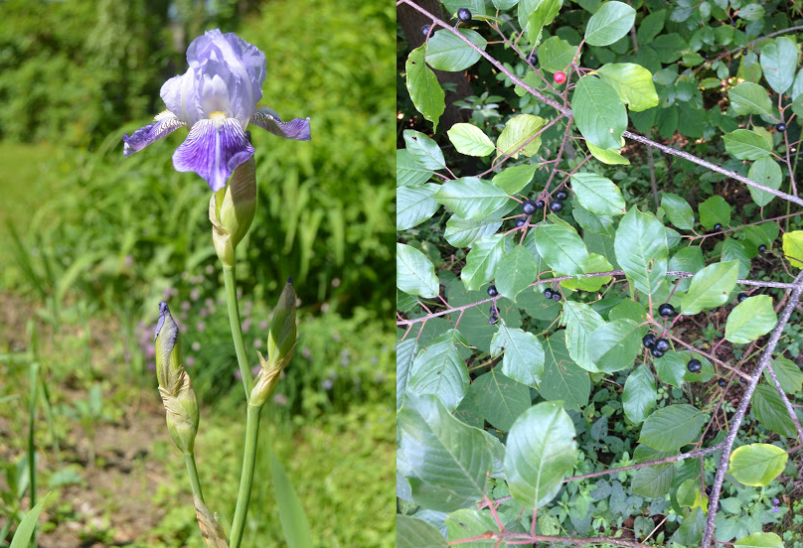
Iris flower and buckthorn berries. Photo by Adrienne d’Evreus.
Sunday, May 1, 2016
Wednesday, April 6, 2016
lye
I am still learning about lye. Here's a list of notes for me and you about what authors and craftsmen who wrote medieval books probably used in their paint-dye-pigment 'recipes'.
A comment from Randy Asplund on Facebook 8/2015 I found very helpful:
Materials and Techniques of Medieval Painting
from woad pg 136-7
Alchemy of Paint
From Geffrei Maudeleyne the way to make it is found here:
From another source Prof. D. V. Thompson translated, De Arte Illuminandi pp. 36-7, footnote 47 "Lye made from the wood of the vine or of oaks is specified in Section 12. p. 8 above. It is of course, to be understood that the lye is made from the ashes of these woods. This is the product generally indicated by the Latin lixivium; its alkalinity depends largely upon the potassium carbonate, 'potash,'
Potassium Carbonate, K2CO3.
A comment from Randy Asplund on Facebook 8/2015 I found very helpful:
"Potash vs. Potash. A while back someone asked me a question about pigment making and the answer involved potash. I don't remember who or exactly what, but I was just thinking that I ought to be more clear and differentiate between the two kinds of potash and the difference between that and "lye" ("ley"). The medieval potash, aka "lixivium" is Potassium CARBONATE (K2CO3) and THAT is the best thing to use in recipes for making things like iris green. That's what they used in the middle ages. You make it. Making it from hardwoods and vines is a diluted product.
The other potash is "caustic potash" which is KOH (potassium HYDROXIDE). You can buy both in crystal form. Be careful, because the crystals are very potent, and the hydroxide version is likely to kill your color.
Avoid using the kitchen lye because it is really caustic. It is NOT what you want."
Materials and Techniques of Medieval Painting
from woad pg 136-7
Alchemy of Paint
From Geffrei Maudeleyne the way to make it is found here:
From another source Prof. D. V. Thompson translated, De Arte Illuminandi pp. 36-7, footnote 47 "Lye made from the wood of the vine or of oaks is specified in Section 12. p. 8 above. It is of course, to be understood that the lye is made from the ashes of these woods. This is the product generally indicated by the Latin lixivium; its alkalinity depends largely upon the potassium carbonate, 'potash,'
K2CO3, extracted from
the ashes. Oak wood, vine branches, beech wood, and particularly
varieties of Artemisia, yield ashes rich in this alkaline carbonate. A
word of warning must be given to experimenters not to use caustic
potash, potassium hydroxide, KOH. Both KOH and NaOH2, sodium hydroxide
are often called lye nowadays, but their use would often lead to failure
in carrying out rules in which the milder carbonate solution, the
common medieval lixivium, is called for. Solutions of commercial K2CO3
may be used safely, to avoid the inconvenience of lixiviating ashes for
the purpose. If the lixivium is to be boiled with quicklime, as
occasionally directed (e.g. Sloane 416, folio 137r. 'A fare fina
lacha'), the potassium carbonate lye should be replaced by the
hydroxide; but in the absence of special indications, the carbonate lye
should be understood. See note 83, p. 45 below"
and in Neven's Strasbourg Manuscript (170)
and in Neven's Strasbourg Manuscript (170)
Thursday, March 17, 2016
Sap Green 2 from Buckthorn berries
This is the continuation of my research on trying the medieval paint recipes for Sap Green from Buckthorn.
Once I figured out what Buckthorn berry bushes looked like I began to see them everywhere. Consequence? More experiments!
I visited my good friend Shana Clark in New Hampshire to raid her local Buckthorn bushes in early September. They were growing in a more open area in more sun than the ones in the first experiment. The branches were full of berries, mostly ripe and dark and with a few green. The next day I sorted them into 53g of green and 341g of ripe berries.
I had already experimented with the Iris Green paint recipe from De Arte Illuminandi with pretty results so I was excited to put the recommendations for Buckthorn to use.
And it's note:
I took 100.00g of ripe buckthorn berries and crushed them with a plastic fork.
In a glazed porcelain (corningware) sauce pan I mixed 11.60g of lye (K2CO3) with about 100g distilled water. Adding 5.05g of alum (aluminum sulfate) resulted in immediate bubbling. The reactions at this point have raised the temperature a little to 80F. Warming the mixture on a simmer burner on low, I hoped to dissolve more of the alum. After about ten minutes the bubbling had mostly stopped, the temperature had risen to 120F and the solution had a pH of 6 with a milky appearance. After heating it up to encourage the alum to dissolve and losing a little in the sink when I poured it into the jar with crushed berries, the total weight of the solution had decreased to 87.07g. There was also a little residue left in the pan.
I mixed the solution into the berries with the same plastic fork I had used to crush them. The next day I found the solution bubbling out of my pint jar! I got rid of the beautifully green paper towel beneath my jar and put it in a glass bowl. As the recipe directs I "let them stand so, out of the way, for three days". After they had rested I used a clean square of linen to strain the juice into another jar.
The next week I painted it out! What a beautiful green!

Once I figured out what Buckthorn berry bushes looked like I began to see them everywhere. Consequence? More experiments!
I visited my good friend Shana Clark in New Hampshire to raid her local Buckthorn bushes in early September. They were growing in a more open area in more sun than the ones in the first experiment. The branches were full of berries, mostly ripe and dark and with a few green. The next day I sorted them into 53g of green and 341g of ripe berries.
I had already experimented with the Iris Green paint recipe from De Arte Illuminandi with pretty results so I was excited to put the recommendations for Buckthorn to use.
 |
| De Arte Illuminandi, pg 7 |
 |
| De Arte Illuminandi (Thompson and Hamilton 43) |
Then the recipe:
 |
| De Arte Illuminandi (Thompson and Hamilton 7) |
Adrienne's Experiment steps:
Research
Collect materials
SAFETY FIRST...
Suit up with nitrile gloves, goggles over glasses and dust mask!
I took 100.00g of ripe buckthorn berries and crushed them with a plastic fork.
In a glazed porcelain (corningware) sauce pan I mixed 11.60g of lye (K2CO3) with about 100g distilled water. Adding 5.05g of alum (aluminum sulfate) resulted in immediate bubbling. The reactions at this point have raised the temperature a little to 80F. Warming the mixture on a simmer burner on low, I hoped to dissolve more of the alum. After about ten minutes the bubbling had mostly stopped, the temperature had risen to 120F and the solution had a pH of 6 with a milky appearance. After heating it up to encourage the alum to dissolve and losing a little in the sink when I poured it into the jar with crushed berries, the total weight of the solution had decreased to 87.07g. There was also a little residue left in the pan.
I mixed the solution into the berries with the same plastic fork I had used to crush them. The next day I found the solution bubbling out of my pint jar! I got rid of the beautifully green paper towel beneath my jar and put it in a glass bowl. As the recipe directs I "let them stand so, out of the way, for three days". After they had rested I used a clean square of linen to strain the juice into another jar.
The next week I painted it out! What a beautiful green!

Sunday, March 13, 2016
Sap Green and yellow from Buckthorn berries
Several important books talk about Sap Green, a medieval and renaissance pigment used in Book illumination among other things. This year I had a mission to make some of this paint using the techniques and methods medieval paint makers may have utilized.
First I made note of all the different recipes for sap green and then had to find the materials these paint makers talk about.
In De Arte Illuminandi, an anonymous 14th century treatise, translated from the Latin by Daniel Varney Thompson, Jr. and George Heard Hamilton in 1933, the author talks about several greens including buckthorn berries. (Thompson and Hamilton, pg 6-7)
Buckthorn Berries are further described by the translators in their note "For the identification of these prugnameroli as buckthorn berries (Buckthorn = It. spincervino, spino gerbino), fruits of the varieties of buckthorn, Rhamnus, see Cennino ed. cit., II, p 32, n 1. (Thompson and Hamilton p 43).
Further reading of this note explains the etymology of Sap Green which has nothing to do with the juice or sap from the plant and berries but how it may have been stored.
"the color known in English as 'Sap Green,' the Italian verde di vescica (so called because the inspissated juice was preserved in bladders), the Saffgrien of Valentine Boltz, who specifies ed. cit., pg 75" the time of year "therefore, in Alsace, the color came out yellow if the berries were gathered in August, and green if they were gathered about the middle of September, we may probably assume that the quality of green yielded by these Rhamnus fruits was not entirely definite." De Arte Illuminandi pg. 29
So, Sap Green and yellow from the Buckthorn...
It took me what felt like forever to find Rhamnus spp. berries. I searched the fields and ditches nearby, went to "Buckthorn Lane" in my local neighborhood in Saco, Maine; I found other trees with other fruits but no Buckthorn! Finally someone said 'look for tall trees, usually somewhere wet' so I went back to my stomping grounds as a teenager in Wesbrook, Maine and found spindly trees in what used to be a protected wetland for turtles. "This?! Is this it?!" I begged my friends to confirm cell phone pictures of my find.

The leaves look right from the plant books, the berries are dark and the bush was spindly and taller than I might have guessed, growing somewhere wet. "Yes!", they chorused, "that looks right, try it!"
So I tried some of the recipes and will post them soon. Sorry it's taken so long!
Saturday, July 18, 2015
Iris experiments 2015
Today (3/26/16) I taught my period pigments class again and we played with some of the pigments I made in 2015. Re-reading this post today I realized that I have learned a lot since then and need to update you all with a new post. I promise this will happen soon after Easter, aka tomorrow.
In the meantime you can explore my page of references, here.

Collecting the blue iris blossoms as they bloomed, May 30th, 2015 for over a week, I ended up with several hundred
flower heads in two gallon sized zip-lock bags. Taking the advice of Wendy
Feldberg, I froze them for later use. Though there were not freezers in
medieval Europe, this seemed like a reasonable compromise with modern obligations.
The chemicals and linen I ordered from Dharma Trading Co. arrived! I used the wrong alum in these recipes, aluminum sulfate. It should be 'rock alum' which is evidently potassium aluminum sulfate. In 2016 I used the correct alum with pretty much the same results. Blue clothlets when they were wet changing to green the more they dried and painting out green.
I washed all of the linen with modern washing machine soap (Free and Clear Tide) and a 1/4 cup of white vinegar.
Not sure of the weights of medieval linen I ordered a yard of each of the three weights available from Dharma Trading Co. 3.5oz, 5oz and 8oz for making clothlets.
In the Materials and Techniques of
Medieval Painting by Daniel V.
Thompson, iris green is described (171). Clothlets are mentioned but not well defined and the process is never described.
Courtesy of Clair Turner I learned that the Glossary of the British Library describes it in depth:
CLOTHLET
A piece of cloth impregnated with PIGMENT (generally a vegetable dye). A portion of such cloth, when soaked in a little BINDING MEDIUM, releases its colorant and produces an artist's pigment. Clothlets are called petiae in Latin and pezze or pezzette in Italian; bisetus folii refers to clothlets dyed with folium, or turnsole, extract. Clothlets were a convenient way of carrying or shipping vegetal pigments, and they were especially popular from the fourteenth century on, with the growth of the textile trade. Glazes of vegetal dyes were often used to enhance other colours in book ILLUMINATION, since they created a rich, glowing, and transparent effect.Randy Asplund then clued me in to Mary Merrifield's Original Treatices and there I found my recipes.


I was excited to get started and in a hurry to get something accomplished so I did what all of my friends and family would tell you I do with all of the recipes I work with: combine techniques from several sources and hope for the best, modifying behavior for the next round based on results!
Also found references in the anonymous treatise De Arte Illuminandi (translated by Varney pgs 7, 15).


Subscribe to:
Posts (Atom)