 |
| Sap Green Buckthorn clothlets 2016 |
Wednesday, September 14, 2016
Buckthorn 2016
It's nearly the 'vintage season' again and that means Buckthorn berry recipes!

Friday, June 17, 2016
Mulling Notes and Resources
Some early sources that describe mulling pigments:
- 12th c De Arte Illuminandi (Thompson and Hamilton 9-10, 14-17, 18)
- 15th c Il Libro Dell'arte (Broecke 56-93)
- 15th c Bolognese MS (Merrifield 502)
- and a slightly later discussion about muller composition in 17th c Brussels MS (Merrifield 770)
Sources for natural pigments to make your own paint. Pigment kits and tools to help it happen:
Safety equipment and resources:- Niosh N95 dust masks
- Nitrile gloves are the standard. They can be found at pharmacies, dollar stores and big box stores as well as onlined.
- Safety Data Sheets (formerly Material Safety Data Sheets)
Beginner Mulling
The medieval methods for grinding
pigments correctly are described in many treatises.
12th c De Arte Illuminandi
(Thompson and Hamilton 9-10, 14-17, 18)
15th c Il Libro Dell'arte
(Broecke 56-93)
15th c Bolognese MS
(Merrifield 502)
and a slightly later discussion about
muller composition in 17th c Brussels MS (Merrifield 770)
Natural Pigments' tutorial on preparing
a grinding surface and making gouache is helpful!
They say mulling is important for
pigment dispersal in the binder and the paint's final appearance.
The steps I use...
Step 1: Gear up; you don't want
to breath or touch even the non-toxic colors. Put a damp white cloth
on your firm surface under the glass slab to increase contrast and
add stability.
Step 2: Prepare glass: I used
silicon carbide with just enough distilled water (DW) to form a paste
the consistency of toothpaste. Used the muller to grind for 5-10
minutes to form a roughened circle on the glass slab as described on
the website. Then I cleaned everything with soap and water.
Step 3: “Now that the
grinding surface has been prepared, you can begin to dispersing [sic]
pigments and making your own paint.” Grind the dry pigments with
distilled water to avoid contamination. Put a walnut sized (Broecke
57) pile of pigment into the center of the slab. Add DW a drop at a
time, mixing with a palette knife or other tool until you reach
toothpaste consistency.
Step 4: “Holding the muller
firmly with the heel of your hand down and your thumb up, slowly move
the muller in a circular motion while keeping the pigment in the
center of the surface. The pigment will slowly accumulate along the
outside of the circle. Use the spatula to move the paste to the
center of the grinding surface in order to continue grinding.
If the paste becomes too stiff, add
more water a few drops at a time... remove any accumulated pigment
from the sides of the muller using a spatula, putty or palette knife.
Sometimes suction will form between the
muller and grinding surface... Use the spatula as a lever to raise an
edge of the muller. Then slide the muller horizontally off the
grinding surface.”
Clean all tools thoroughly between each
color; observing your local toxic water disposal requirements.
Step 5: Combine mulled pigment
with a binder. I use commercial gum Arabic from Winsor and Newton.
Other binders include glair (egg white), egg yolk and other gums.
References:
Broecke,
Lara. Cennino Cennini's Il libro dell'arte, A new
English translation and commentary with Italian transcription.
London: Archetype Publications Ltd., 2015.
Merrifield,
Mary P. Original Treatises: Dating from the XIIth to
XVIIIth Centuries on the Arts of Painting, in Oil, Miniature, Mosaic,
and on Glass; of Gilding, Dyeing, and the Preparation of Colours and
Artificial Gems; Preceded by a General Introduction; with
Translations, Prefaces, and Notes, In Two Volumes. London: John
Murray, Albemarle Street, 1849.
Medieval and Renaissance Treatises on the Arts of Painting, Original Texts with English Translations. Two Volumes bound as one. New York: Dover Publications, Inc, 1967.
Medieval and Renaissance Treatises on the Arts of Painting, Original Texts with English Translations. Two Volumes bound as one. New York: Dover Publications, Inc, 1967.
O'Hanlon,
George. Making Your Own Water-Based Paint. 2015.
Thompson,
Daniel Varney and Hamilton, George Hurd. De Arte
Illuminandi, the Technique of Manuscript Illumination. New Haven:
Yale University Press, 1933.
Thompson, Daniel V. The Materials
and Techniques of Medieval Painting. Dover Publications, Inc.,
New York, 1956.
Adrienne d'Evreus, 2016.
http://scientistsscroll.blogspot.com
Friday, May 20, 2016
'levigation' and 'elutriation'
It's super funny to find out you've been using a fancy word because you think you're smart and always right... and you've been using it wrong! Or not!
Wednesday, May 4, 2016

EK Gazette Iris and Sap Green
Arts & Sciences Research Paper #9: Making green paint medievally with spring irises and fall buckthorn berries
02 Monday May 2016Posted by mollyeskridge in A&S Research Papers, Arts and Sciences
#9: Making green paint medievally with spring irises and fall buckthorn berries
Tags
a&s, Arts and Sciences
Our ninth A&S Research Paper comes to us from Lady Adrienne d’Evreus, of the Province of Malagentia. She turns to the flora of her woodlands to learn ways that medieval painters made green pigments. (Prospective future contributors, please check out our original Call for Papers.)
Making green paint medievally with spring
irises and fall buckthorn berries
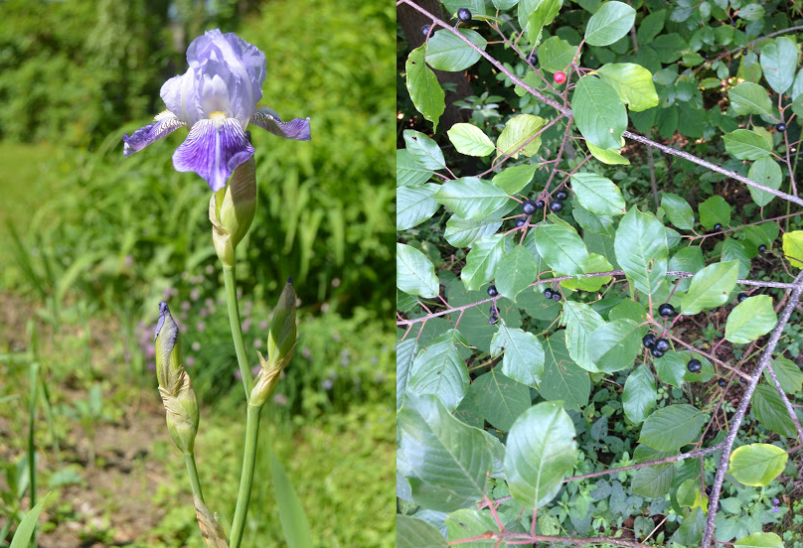
Iris flower and buckthorn berries. Photo by Adrienne d’Evreus.
Sunday, May 1, 2016
Subscribe to:
Posts (Atom)