Showing posts with label Alum. Show all posts

Saturday, April 7, 2018

lulax means indigo

Looking for another 'vegetable blue' I found this reference. I have seen 'lulax'  few times and see that Mappae Clavicula as translated by Smith and Hawthorne has this note:


or does it...
perhaps it just means a certain color blue?
Smith and Hawthorn 55


Monday, January 16, 2017

2016 Buckthorn with vinegar paint results

Here are the paint results from these buckthorn and vinegar recipes in 2016.


I was able to make a nice sap green from the buckthorn with white wine vinegar by adding a little potassium aluminum sulfate (alum).


Note that the 25% acidic vinegar and buckthorn produced a thick juice that required more thinning and would require more water and more gum Arabic to produce a smooth paint.


When I added alum to both buckthorn and vinegar recipe it resulted in green!  By itself, the results were less satisfying and not what I would call green but more blue gray.

Side note: I think the shininess on the first two swatches is the result of a little too much gum Arabic.

Buckthorn with vinegar, twice in 2016

In 2016 I tried twice more to get green for paint or dye/stain from buckthorn.

Bolognese MS De Tintis ad Tigendum Pellum (Merrifield 426)

Sunday, January 15, 2017

2016 sap green from Buckthorn Experiment 2 Results

This experiment began in November 2016 and was finished up at the beginning of 2017.

The ripe buckthorn, Rhamnus spp., juice had been extracted from refrigerated, and slightly dessicated buckthorn berries from Saco, Maine. The berries were reconstituted with distilled water (DW), and then rock alum (potassium aluminum sulfate) was added to the juice.  Commercially available gum Arabic was then used with distilled water to paint it out on 12/23/16.

By 12/29/16 the dark blue had turned to dark green and further trials were performed. 


The change of color from blue to green suggests a few possibilities to me.  Either the alum had a chance to change the buckthorn after sitting with it for a while or it could have come into contact with calcium carbonate contaminates from the enviornment like egg or clam shell (neither of which are scarce in my house) or the Strathmore Bristol vellum finish paper is prepared with a buffer that reacted with the acids and berry juice. 

Further trials were painted out from the original berry juice with alum in the palette and shell with gum.  More distilled water was used to re-hydrate the paint and thin it out for greater visibility.


The juice with alum alone, in a clam shell and with crushed egg shell all yield what I would describe as a gentle sap green.  The trial with lye turned from a rather interesting olive to quite a bright yellow reminiscent of the yellow yielded from the green buckthorn drupes and in another ripe drupe recipe discussed here.

Buckthorn sap green Experiment 2, 2016

Merrifield 420 with variables

Tuesday, October 4, 2016

Iris Green 2016

Last year for my pigment experiments I used aluminum sulfate from a dye company thinking that was the right kind of alum.  In 2016 I made Iris green clothlets with the medievally recommended alum, Rock Alum, which I learned is aluminum potassium sulfate or potassium aluminum sulfate, KAl(SO4)2·12H2O.

Iris Green Clothlets 2016 from De Arte Illuminandi

 Click "read more" below to find out how!

Friday, September 16, 2016

Buckthorn yellow 2016

This year I decided to try using concepts from De Arte Illuminandi to try unripe, green berries to make yellow, a possibility indicated by the translators.
Two pigments were and are derived from Rhamnus berries; a yellow and a green.  The product of the unripe berries is the Giallo santo (cf. M. P. Merrifield, op cit., I clxiv), known in English by the extraordinary names, "Italian Pink" and "Dutch Pink."(Thompson and Hamilton 43)

That page of Merrifield's text explains,
 Giallo santo was a kind of yellow lake, which was made from various plants.  It was sometimes prepared from the berries of buckthorn (Merrifield clxiv)

and the result is reinforced by the Pigment Compendium that explains,
various species of the Rhamnacea family give a yellow dye on extraction of the unripe berries (drupes)
 It seems that the medieval artists more commonly would have probably used the local ochers from the land or orpiment, arsenic sulfide, or one of the lead yellows... but I have buckthorn berries from Saco, that I picked, for free, and don't feel like playing with arsenic or lead today!  

Here's a preview picture of them, 

yellow clothlets from green buckthorn berries in the foreground, sap green clothlets behind
And now I'll explain how I made them, just click 'read more' below.

Wednesday, September 14, 2016

Wednesday, May 4, 2016

EK Gazette Iris and Sap Green

Arts & Sciences Research Paper #9: Making green paint medievally with spring irises and fall buckthorn berries

02 Monday May 2016
Posted by mollyeskridge in A&S Research Papers, Arts and Sciences
#9: Making green paint medievally with spring irises and fall buckthorn berries
Tags
a&s, Arts and Sciences
Our ninth A&S Research Paper comes to us from Lady Adrienne d’Evreus, of the Province of Malagentia. She turns to the flora of her woodlands to learn ways that medieval painters made green pigments. (Prospective future contributors, please check out our original Call for Papers.)
Making green paint medievally with spring irises and fall buckthorn berries
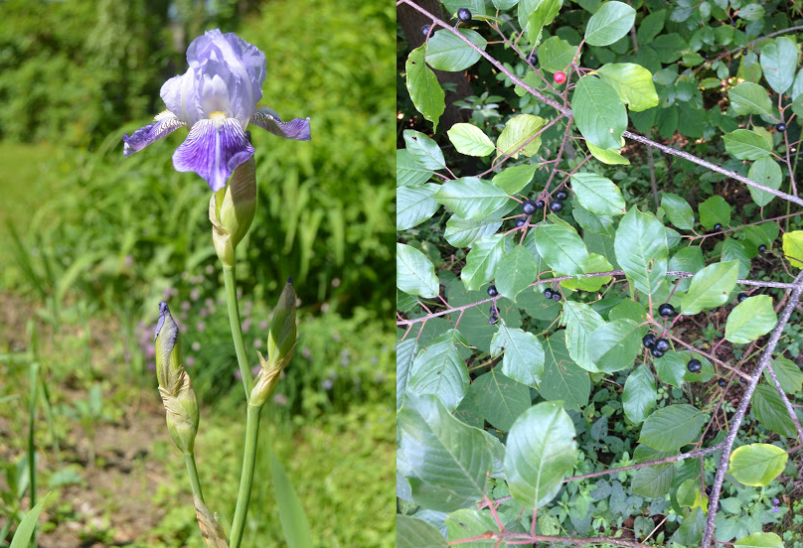
Iris flower and buckthorn berries
Iris flower and buckthorn berries. Photo by Adrienne d’Evreus.

Tuesday, April 12, 2016

Rock Alum

This is my silly "rock alum" saga. 

The bottom line is that alum in medieval paint recipes is Potassium Aluminum Sulfate KAl3(SO4)2(OH)6.  

Read on for how I learned this.

Tuesday, March 22, 2016

Buckthorn berries, Yellow Experiment(s) 2

I tried to begin to follow another source to produce yellow.  I was working from Merrifield's Bolognese Manuscript, De Fiendis Viridibus again!  This book is so big, I'll never run out of possibilities. :D I will, ultimately, have to read it cover to cover.  I know I'm missing her details about general color production, opinions and her references.


Merrifield pg 428
The last ripe berries from Shana's New Hampshire Buckthorn bushes, about 30g, only yielded about 20 drops of juice so that attempt was unsuccessful.  At the end of September I found Buckthorn across the street in Saco.  I acquired the appropriate permission and went picking berries.  Someday I need to find an identification key for these Rhamnus spp bushes.  These berries seem plumper and larger, it must be a different variety or maybe they're just really ripe?
The 189g of big, juicy berries were manually squished with gloved hands and squeezed through cheesecloth to yield about 63g sludgy juice that I closed in a jar.
With fall archery events we were busy for more than the next month.  The juice sat closed in the jar for almost five weeks.  That was longer than the instructions indicated but I'm a volunteer... busy with being an archery safety officer and regular life activities when I'm not doing scribal or other Arts&Sciences projects!
I noted that when I finally opened the jar that the juice was definitely fermented and smelled like wine.
Athena Thickstun's blog helped me define that a 'fiasco' of wine is 2 liters.  One quarter of that would be 500g.  I didn't need that much so I made a smaller batch. Taking 200g distilled water I added a teaspoon of lye, K2CO3 (<1g on the kitchen scale that I had access to since I flooded the little one I had been using).  Then I added about the same quantity of alum (aluminum sulfate Al2(SO4)3. which resulted in immediate fizzling.  [I have since found out that that is the wrong alum.  Next time I will use rock alum which I have learned is KAl(SO4)2.]  As instructed I heated it in my corning ware sauce pot on low for the time that it took me to recite the Our Father prayer in Latin:
Pater noster qui es in coelis sanctificetur nomen tuum.
Adveniat regnum tuum. Fiat voluntas tua sicut in coela et in terra.
Panem nostrum quotidianum da nobis hodie.
Et dimitte nobis debita nostra, sicut et nos demittimus debitoribus nostris.
Et ne nos inducas in temptationem.
Sed libera nos a malo.
Amen.
Adding the prepared lye/alum/water to the jar of juice there was an immediate color change of the reddish juice to a yellow/green liquid.

"Very fine white earth like the fellmongers use" is defined in Alexander's glossary in the Dover edition of Merrifield's treatises as lime.

In the spring of 2016 I was able to come back to this experiment.

I found pulverized (vs. pelletized) lime at one of the big box garden centers.


Speaking to Randy Asplund about it again he advised that I was basically making a lake pigment and elaborated on the volume of a mezetta, "In Florence the mezzetta was equal to 0.7613 liters."  I recalled that I had made a smaller volume and not very accurately measured the lye and water in the fall because my little scale had died the quick death of drowning in a different experiment.  Water under the bridge; I'll know the correct mezzetta volume next time!  Regardless, this might have worked anyway.

Back to creating a lake pigment... Cool!  I have never made a lake.  The Materials and Techniques of medieval painting talks about brazil lakes:
Sometimes the decoction of brazil wood with alum was precipitated with chalk, and a more opaque, pink, rose colour was produced by the resulting admixture of calcium sulphate to the alumina lake.  Sometimes, in England, instead of adding chalk to the solution, a chalk stone was hollowed out, and little holes were made in the bottom of the hollow, and the hot alum solution coloured with brazil was poured into the hollow of the chalk.  The reaction between the alum and the chalk took place at the surface of the chalk stone, in that case, and a crust of semi-opaque brazil lake was formed in the hollow and in the little holes.
When lakes were made by precipitating the alum solution with the chalk, the calcium sulphate was formed automatically along with the lake, in intimate combination with it.  Sometimes brazil lakes were given some opacity by adding opaque substances to them at the moment of precipitation, and even after.  When white lead was used, as it sometimes was, it had no other effect than to give a little substance to the lake, to make it a little less transparent, and to develop the rosy colour.  when marble dust and powdered egg shells were added to the newly formed lakes, or introduced along with the precipitating agent, they probably had the further effect of controlling the colour produced by reacting chemically with any excess of alum which might give a brown cast instead of the desired rose.  In all these cases the brazil colour was mordanted upon the white material, whether calcium sulphate, or an excess of chalk, or white lead, or marble dust, or powered egg shells.  The white substances were, so to speak, dyed with the brazil; and the pigment so formed was different from a mixture of a finished lake with the white pigment. (Thompson 119)
So, since I'm making a lake, I tried both crushed eggshell and pulverized lime.  I took about 10 g of each and pipetted off about 5 g of liquid from the jar into each material.  The eggshell is probably not pulverized enough to paint with.  I wonder if I can mull it or crush it down and use it anyway.  And just maybe add more of the buckthorn/aluminum sulfate/lye juice after "in order that it may become more beautiful and of a brighter colour" (Merrifield 428)

Buckthorn yellow.  Ripe buckthorn berry juice with lye and aluminum sulfate with crushed eggshell.

Buckthorn yellow.  Ripe buckthorn berry juice with lye and aluminum sulfate with pulverized lime.
This experiment produced beautiful yellows!  Some day I'll try to paint with them.  I bet you can paint with the plain juice like with the sap green as a transparent glaze.  I wonder if you can make a green lake with that juice with lime or eggshells too.  Anyway, yay yellow!

Mr. Asplund advises that this yellow lake can be produced in the same way from green berries too.  Awesome!

Tuesday, March 15, 2016

Medieval Mappae Clavicula Elderberry Paint Recipe

Last year I posted some medieval recipes for blue paint from elderberries here.  And the testing of it as blue paint here.

I am excited to expand the post to include pictures of a manuscript of the Mappae Clavicula, one of the medieval recipe sources I used.  The manuscript is held at Rakow Research Library which is part of The Corning Museum of Glass.   The entire manuscript can be downloaded from their website here.

This picture is provided by the courtesy of the Rakow Research Library, The Corning Museum of Glass.

This table of contents entry is toward the beginning of the parchment leaves.  The numbers were penned in red ink probably after at least most of the book was written. We'll see the red ink again later.

To me the latin content entry reads:
lxxxiii
Indicum colorem facere.
Which can be translated as
eighty-three
To make an indigo color.
In the manuscript we find the page with the description of how to make the blue color.  Note the different colored inks used again.  This time perhaps to designate titles versus instruction.

This picture is also provided by the courtesy of the Rakow Research Library, The Corning Museum of Glass.

Mostly trusting and heavily relying on the Latin edition found on Corning's website here, on page 28 which can be accessed by typing in 32 of 70 pages in the downloadable pdf, the abbreviated latin probably reads as:
Indicum colorem facere.  Succum de ba(c)cis ebuli collige et diligenter sicca at solem de hoc quod remanserit fac pastillos cum parvo aceti et vini et utere 
According to a magazine I interlibrary loaned, Transactions of the American Philosophical Society held at Philidelphia for promoting useful knowledge, New Series Volume 64 part 4 written by Smith and Hawthorne in 1974 in the article "Mappae Clavicula, a little key to the world of Medieval Techniques", it can be translated as:
97. Making indigo pigment.  Collect the juice of dwarf elderberries and dry it thoroughly in the sun.  From what remains make pastilles with a little vinegar and wine, then use it.
I would have translated "Indicum color facere." as "make indigo color" but high school Latin class was a long time ago now. Perhaps the disagreement with what number of the recipe has to do with either different manuscript versions, mis-translation (probably by me, I'm pretty new at deciphering manuscripts) or the numbering being added either after the book was done by the original scribe or by a different scribe, perhaps even at a different time. I have not finished reading all of the resources on the internet about Mappae Clavicula; maybe I'll eventually find more theories about the differences but I wanted to share the great references provided by the Corning Museum of Glass and it's Rakow Research Library. Go check out that manuscript; it's great!

Saturday, July 18, 2015

Iris experiments 2015

Today (3/26/16) I taught my period pigments class again and we played with some of the pigments I made in 2015.  Re-reading this post today I realized that I have learned a lot since then and need to update you all with a new post.  I promise this will happen soon after Easter, aka tomorrow.

In the meantime you can explore my page of references, here.


Collecting the blue iris blossoms as they bloomed, May 30th, 2015 for over a week, I ended up with several hundred flower heads in two gallon sized zip-lock bags.  Taking the advice of Wendy Feldberg, I froze them for later use.  Though there were not freezers in medieval Europe, this seemed like a reasonable compromise with modern obligations.

The chemicals and linen I ordered from Dharma Trading Co. arrived!  I used the wrong alum in these recipes, aluminum sulfate.  It should be 'rock alum' which is evidently potassium aluminum sulfate.  In 2016 I used the correct alum with pretty much the same results.  Blue clothlets when they were wet changing to green the more they dried and painting out green.

I washed all of the linen with modern washing machine soap (Free and Clear Tide) and a 1/4 cup of white vinegar.
Not sure of the weights of medieval linen I ordered a yard of each of the three weights available from Dharma Trading Co. 3.5oz, 5oz and 8oz for making clothlets.

In the Materials and Techniques of Medieval Painting by Daniel V. Thompson, iris green is described (171).  Clothlets are mentioned but not well defined and the process is never described.

Courtesy of Clair Turner I learned that the Glossary of the British Library describes it in depth:


CLOTHLET

A piece of cloth impregnated with PIGMENT (generally a vegetable dye). A portion of such cloth, when soaked in a little BINDING MEDIUM, releases its colorant and produces an artist's pigment. Clothlets are called petiae in Latin and pezze or pezzette in Italian; bisetus folii refers to clothlets dyed with folium, or turnsole, extract. Clothlets were a convenient way of carrying or shipping vegetal pigments, and they were especially popular from the fourteenth century on, with the growth of the textile trade. Glazes of vegetal dyes were often used to enhance other colours in book ILLUMINATION, since they created a rich, glowing, and transparent effect.


Randy Asplund then clued me in to Mary Merrifield's Original Treatices and there I found my recipes. 

Based somewhat on the recipe translations in her book I made clothlets and prepared egg shells and clam shells with iris juice and a pinch of alum.
I was excited to get started and in a hurry to get something accomplished so I did what all of my friends and family would tell you I do with all of the recipes I work with:  combine techniques from several sources and hope for the best, modifying behavior for the next round based on results!
Also found references in the anonymous treatise  De Arte Illuminandi (translated by Varney pgs 7, 15).


And the paint results from August can be found here: