From lime or calcined wine lees
Strasbourg Manuscript: lye from calcined wine lees (Neven 170) who quotes Colmarer Kunstbuch.
Alchemy of Paint
Bucklow (28-29, 48, 61-64, 69,75,109, 200)
First Lye post with personal references
Showing posts with label Pigment Making. Show all posts
Showing posts with label Pigment Making. Show all posts
Monday, July 9, 2018

Tuesday, May 8, 2018
woad 2017
A brief word about indigo containing plants first. In my studies I have learned that indigo blue can be isolated from at least three different plants: woad (Isatis tinctoria), "bagdad" indigo (Indigofera tinctoria), and Japanese Indigo (Persicaria tinctoria/Polygonum tinctorum). The first time I tried Indigofera tinctoria I only got two plants to germinate at all and they yielded no blue. The same year, 2015, I grew Isatis tinctoria and yielded a little success but only sufficient florey in my vat to paint out one circle of blue that I evidently didn't take pictures of. 2016 was the summer we moved. There were no extant gardens on the property and not enough energy to install them until 2017.
In 2017 I grew woad, Isatis tinctoria, in three large red planters in the front garden at the new house in Windham. I was more careful to feed the plants well in 2017. Two of the pots were only "50/50" mix from the garden center who said "It's really about 70/30 loam and Benson's. Any richer would burn your plants." And the third pot included amazing compost from an acquaintance of my mom who makes it with kitchen scraps and mess from his chicken coop.

In 2017 I grew woad, Isatis tinctoria, in three large red planters in the front garden at the new house in Windham. I was more careful to feed the plants well in 2017. Two of the pots were only "50/50" mix from the garden center who said "It's really about 70/30 loam and Benson's. Any richer would burn your plants." And the third pot included amazing compost from an acquaintance of my mom who makes it with kitchen scraps and mess from his chicken coop.

Sunday, May 6, 2018
Medieval Manuscript Garlic references 2017
The juice of hard necked garlic, Allium sativum, grown across the world in northern latitudes, may be used for all sorts of culinary applications as well as a gilding binder and more.
Read more by clicking through!
 | ||||
| Allium sativum scapes growing 2017 |
Read more by clicking through!
More Saffron yellow resources
From Booke of Secrets:
And another from a translation of Simone's MS 1793 in the Getty's Historical Painting:
Another yellow
Mix saffron with the yolke of an eg, and it maketh a faire shining colour. Otherwise.
Put saffron and alum into a clout, and put vineger into it, and strain it out: or take saffron, the yolke of an eg, gum Arabike and alum, and mix them together.
And another from a translation of Simone's MS 1793 in the Getty's Historical Painting:
 |
| Wallert 1996 |
Monday, January 16, 2017
2016 Buckthorn with vinegar paint results
Here are the paint results from these buckthorn and vinegar recipes in 2016.


Note that the 25% acidic vinegar and buckthorn produced a thick juice that required more thinning and would require more water and more gum Arabic to produce a smooth paint.

When I added alum to both buckthorn and vinegar recipe it resulted in green! By itself, the results were less satisfying and not what I would call green but more blue gray.
Side note: I think the shininess on the first two swatches is the result of a little too much gum Arabic.

I was able to make a nice sap green from the buckthorn with white wine vinegar by adding a little potassium aluminum sulfate (alum).


When I added alum to both buckthorn and vinegar recipe it resulted in green! By itself, the results were less satisfying and not what I would call green but more blue gray.
Side note: I think the shininess on the first two swatches is the result of a little too much gum Arabic.
Buckthorn with vinegar, twice in 2016
In 2016 I tried twice more to get green for paint or dye/stain from buckthorn.
 |
| Bolognese MS De Tintis ad Tigendum Pellum (Merrifield 426) |
Sunday, January 15, 2017
2016 sap green from Buckthorn Experiment 2 Results
This experiment began in November 2016 and was finished up at the beginning of 2017.
The ripe buckthorn, Rhamnus spp., juice had been extracted from refrigerated, and slightly dessicated buckthorn berries from Saco, Maine. The berries were reconstituted with distilled water (DW), and then rock alum (potassium aluminum sulfate) was added to the juice. Commercially available gum Arabic was then used with distilled water to paint it out on 12/23/16.
By 12/29/16 the dark blue had turned to dark green and further trials were performed.

The change of color from blue to green suggests a few possibilities to me. Either the alum had a chance to change the buckthorn after sitting with it for a while or it could have come into contact with calcium carbonate contaminates from the enviornment like egg or clam shell (neither of which are scarce in my house) or the Strathmore Bristol vellum finish paper is prepared with a buffer that reacted with the acids and berry juice.
Further trials were painted out from the original berry juice with alum in the palette and shell with gum. More distilled water was used to re-hydrate the paint and thin it out for greater visibility.

The juice with alum alone, in a clam shell and with crushed egg shell all yield what I would describe as a gentle sap green. The trial with lye turned from a rather interesting olive to quite a bright yellow reminiscent of the yellow yielded from the green buckthorn drupes and in another ripe drupe recipe discussed here.
The ripe buckthorn, Rhamnus spp., juice had been extracted from refrigerated, and slightly dessicated buckthorn berries from Saco, Maine. The berries were reconstituted with distilled water (DW), and then rock alum (potassium aluminum sulfate) was added to the juice. Commercially available gum Arabic was then used with distilled water to paint it out on 12/23/16.
By 12/29/16 the dark blue had turned to dark green and further trials were performed.

The change of color from blue to green suggests a few possibilities to me. Either the alum had a chance to change the buckthorn after sitting with it for a while or it could have come into contact with calcium carbonate contaminates from the enviornment like egg or clam shell (neither of which are scarce in my house) or the Strathmore Bristol vellum finish paper is prepared with a buffer that reacted with the acids and berry juice.
Further trials were painted out from the original berry juice with alum in the palette and shell with gum. More distilled water was used to re-hydrate the paint and thin it out for greater visibility.

The juice with alum alone, in a clam shell and with crushed egg shell all yield what I would describe as a gentle sap green. The trial with lye turned from a rather interesting olive to quite a bright yellow reminiscent of the yellow yielded from the green buckthorn drupes and in another ripe drupe recipe discussed here.

Tuesday, October 4, 2016
Iris Green 2016
Last year for my pigment experiments I used aluminum sulfate from a dye company thinking that was the right kind of alum. In 2016 I made Iris green clothlets with the medievally recommended alum, Rock Alum, which I learned is aluminum potassium sulfate or potassium aluminum sulfate, KAl(SO4)2·12H2O.
 |
| Iris Green Clothlets 2016 from De Arte Illuminandi |
Click "read more" below to find out how!
creating clothlets
I first learned about clothlets from Thompson's The Materials and Techniques of Medieval Painting. It's sort of generic but encouraged me to do more digging...
'the generic name, however, for cloths saturated in the colours was petia in Latin, and pezza or pezzetta in Italian...Clothlets were a most convenient form of colours for illuminators. It was only necessary to put a bit of clothlet in a dish, and wet with a little glair or gum water, and the colour would dissolve out of the cloth into the binding medium, forming a transparent stain. A good many colours were prepared in this way for late medieval book painting...' pg 144
From the British Library's Catalogue of
Illuminated Manuscripts glossary we find.
Clothlet: "A piece of cloth impregnated with PIGMENT (generally a vegetable dye). A portion of such cloth, when soaked in a little BINDING MEDIUM, releases its colorant and produces an artist's pigment. Clothlets are called petiae in Latin and pezze or pezzette in Italian; bisetus folii refers to clothlets dyed with folium, or turnsole, extract. Clothlets were a convenient way of carrying or shipping vegetal pigments, and they were especially popular from the fourteenth century on, with the growth of the textile trade. Glazes of vegetable dyes were often used to enhance other colours in book ILLUMINATION, since they created a rich, glowing, and transparent effect."
You can also find mention of them in this Getty Publication. Once you start knowing what to look for, you will see a lot of references.
As the addage goes, 'Cleanliness is next to Godliness', so this year I took the recommendation of Jenny Dean in her book Wild Color scouring the linen for my clothlets. I bought 'natural linen' from JoAnne Fabrics. I don't know if it really is natural or it's dyed to look natural.
First I soaked it overnight in clear water filtered through my reverse osmosis (RO)filter. In the morning, the water was light brown. Yuck! So, fabric from the fabric store is not actually the cleanest it can be, got it!

I dumped it out and refilled it with new clean, filtered water and measure 1 tsp dish soap (Dawn) and 2 Tbsp washing soda.

I boiled it for about four hours.
When I pour out the water after boiling it is dark brown and quite dirty!

At this point I abandon the Reverse Osmosis filtered water and rinse in tap water until the water runs clear then wash it twice in my washing machine and air dry the linen.
Looking at the internet it appears that 'finger' was commonly used to measure cloth and 'fistmele' I know from archery. I used my index finger and fist to extended thumb to measure the clothlets. We are in the modern world so I use my fabric scissors to cut the pieces to size. Though we know medieval people had scissors too! Next time I may use 'span' as I see that frequently as I poke around now.
Regardless, I now have clean rectangles of fabric for the next steps. Yay!
Regardless, I now have clean rectangles of fabric for the next steps. Yay!
Friday, September 16, 2016
Buckthorn yellow 2016
This year I decided to try using concepts from De Arte Illuminandi to try unripe, green berries to make yellow, a possibility indicated by the translators.
That page of Merrifield's text explains,
and the result is reinforced by the Pigment Compendium that explains,
Here's a preview picture of them,
And now I'll explain how I made them, just click 'read more' below.
Two pigments were and are derived from Rhamnus berries; a yellow and a green. The product of the unripe berries is the Giallo santo (cf. M. P. Merrifield, op cit., I clxiv), known in English by the extraordinary names, "Italian Pink" and "Dutch Pink."(Thompson and Hamilton 43)
That page of Merrifield's text explains,
Giallo santo was a kind of yellow lake, which was made from various plants. It was sometimes prepared from the berries of buckthorn (Merrifield clxiv)
and the result is reinforced by the Pigment Compendium that explains,
various species of the Rhamnacea family give a yellow dye on extraction of the unripe berries (drupes)It seems that the medieval artists more commonly would have probably used the local ochers from the land or orpiment, arsenic sulfide, or one of the lead yellows... but I have buckthorn berries from Saco, that I picked, for free, and don't feel like playing with arsenic or lead today!
Here's a preview picture of them,
 |
| yellow clothlets from green buckthorn berries in the foreground, sap green clothlets behind |
Wednesday, September 14, 2016
Buckthorn 2016
It's nearly the 'vintage season' again and that means Buckthorn berry recipes!
 |
| Sap Green Buckthorn clothlets 2016 |
Friday, June 17, 2016
Mulling Notes and Resources
Some early sources that describe mulling pigments:
- 12th c De Arte Illuminandi (Thompson and Hamilton 9-10, 14-17, 18)
- 15th c Il Libro Dell'arte (Broecke 56-93)
- 15th c Bolognese MS (Merrifield 502)
- and a slightly later discussion about muller composition in 17th c Brussels MS (Merrifield 770)
Sources for natural pigments to make your own paint. Pigment kits and tools to help it happen:
Safety equipment and resources:- Niosh N95 dust masks
- Nitrile gloves are the standard. They can be found at pharmacies, dollar stores and big box stores as well as onlined.
- Safety Data Sheets (formerly Material Safety Data Sheets)
Beginner Mulling
The medieval methods for grinding
pigments correctly are described in many treatises.
12th c De Arte Illuminandi
(Thompson and Hamilton 9-10, 14-17, 18)
15th c Il Libro Dell'arte
(Broecke 56-93)
15th c Bolognese MS
(Merrifield 502)
and a slightly later discussion about
muller composition in 17th c Brussels MS (Merrifield 770)
Natural Pigments' tutorial on preparing
a grinding surface and making gouache is helpful!
They say mulling is important for
pigment dispersal in the binder and the paint's final appearance.
The steps I use...
Step 1: Gear up; you don't want
to breath or touch even the non-toxic colors. Put a damp white cloth
on your firm surface under the glass slab to increase contrast and
add stability.
Step 2: Prepare glass: I used
silicon carbide with just enough distilled water (DW) to form a paste
the consistency of toothpaste. Used the muller to grind for 5-10
minutes to form a roughened circle on the glass slab as described on
the website. Then I cleaned everything with soap and water.
Step 3: “Now that the
grinding surface has been prepared, you can begin to dispersing [sic]
pigments and making your own paint.” Grind the dry pigments with
distilled water to avoid contamination. Put a walnut sized (Broecke
57) pile of pigment into the center of the slab. Add DW a drop at a
time, mixing with a palette knife or other tool until you reach
toothpaste consistency.
Step 4: “Holding the muller
firmly with the heel of your hand down and your thumb up, slowly move
the muller in a circular motion while keeping the pigment in the
center of the surface. The pigment will slowly accumulate along the
outside of the circle. Use the spatula to move the paste to the
center of the grinding surface in order to continue grinding.
If the paste becomes too stiff, add
more water a few drops at a time... remove any accumulated pigment
from the sides of the muller using a spatula, putty or palette knife.
Sometimes suction will form between the
muller and grinding surface... Use the spatula as a lever to raise an
edge of the muller. Then slide the muller horizontally off the
grinding surface.”
Clean all tools thoroughly between each
color; observing your local toxic water disposal requirements.
Step 5: Combine mulled pigment
with a binder. I use commercial gum Arabic from Winsor and Newton.
Other binders include glair (egg white), egg yolk and other gums.
References:
Broecke,
Lara. Cennino Cennini's Il libro dell'arte, A new
English translation and commentary with Italian transcription.
London: Archetype Publications Ltd., 2015.
Merrifield,
Mary P. Original Treatises: Dating from the XIIth to
XVIIIth Centuries on the Arts of Painting, in Oil, Miniature, Mosaic,
and on Glass; of Gilding, Dyeing, and the Preparation of Colours and
Artificial Gems; Preceded by a General Introduction; with
Translations, Prefaces, and Notes, In Two Volumes. London: John
Murray, Albemarle Street, 1849.
Medieval and Renaissance Treatises on the Arts of Painting, Original Texts with English Translations. Two Volumes bound as one. New York: Dover Publications, Inc, 1967.
Medieval and Renaissance Treatises on the Arts of Painting, Original Texts with English Translations. Two Volumes bound as one. New York: Dover Publications, Inc, 1967.
O'Hanlon,
George. Making Your Own Water-Based Paint. 2015.
Thompson,
Daniel Varney and Hamilton, George Hurd. De Arte
Illuminandi, the Technique of Manuscript Illumination. New Haven:
Yale University Press, 1933.
Thompson, Daniel V. The Materials
and Techniques of Medieval Painting. Dover Publications, Inc.,
New York, 1956.
Adrienne d'Evreus, 2016.
http://scientistsscroll.blogspot.com
Wednesday, May 4, 2016

EK Gazette Iris and Sap Green
Arts & Sciences Research Paper #9: Making green paint medievally with spring irises and fall buckthorn berries
02 Monday May 2016Posted by mollyeskridge in A&S Research Papers, Arts and Sciences
#9: Making green paint medievally with spring irises and fall buckthorn berries
Tags
a&s, Arts and Sciences
Our ninth A&S Research Paper comes to us from Lady Adrienne d’Evreus, of the Province of Malagentia. She turns to the flora of her woodlands to learn ways that medieval painters made green pigments. (Prospective future contributors, please check out our original Call for Papers.)
Making green paint medievally with spring
irises and fall buckthorn berries
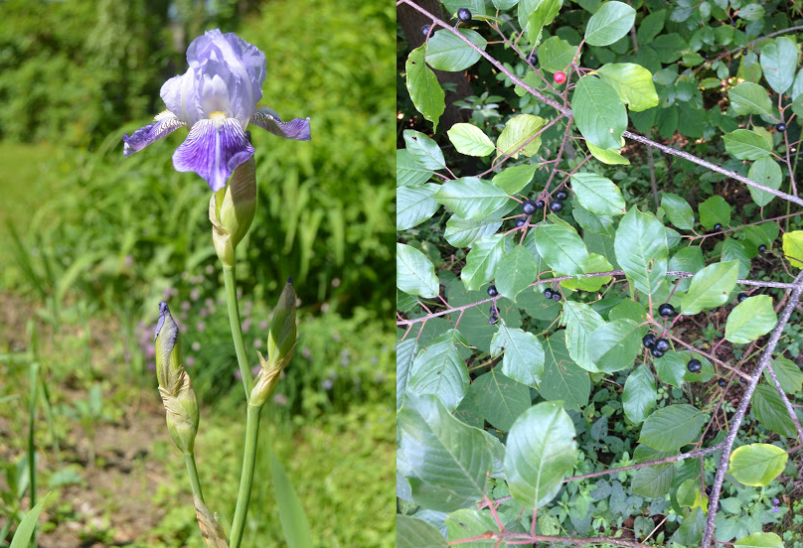
Iris flower and buckthorn berries. Photo by Adrienne d’Evreus.
Sunday, May 1, 2016
Saturday, April 30, 2016
Saffron paint
One of the first pigment experiments I did was with saffron. Didn't it turn out pretty?!
 Read on for my references and methods...

Tuesday, April 26, 2016
Saturday, April 16, 2016
indigo
Indigo (Indigofera tinctoria)
4/13/15 Soaked seeds in water overnight.
4/14/15 Planted 2 seeds each in three 4" pots,
three seeds each in three 4" pots, none of these germinated.
Planted more outside in pots 5/30/15, two seeds germinated and grew.
Plant matter never yielded blue
4/13/15 Soaked seeds in water overnight.
4/14/15 Planted 2 seeds each in three 4" pots,
three seeds each in three 4" pots, none of these germinated.
Planted more outside in pots 5/30/15, two seeds germinated and grew.
Plant matter never yielded blue
Subscribe to:
Posts (Atom)