Showing posts with label Buckthorn. Show all posts

Monday, May 29, 2017

Exploring "Italian pink" and "Dutch pink"

"Dutch pink"and "Italian pink", probably actually green and yellow pigments, are mentioned to in a note in De Arte Illuminandi (Thompson and Hamilton 43).

68 For the identification of these prugnameroli as buckthorn berries (buckthorn = It. spincervino, spino gerbino), fruits of varieties of the buckthorn, Rhamnus, see Cennino, ed.cit., II, 32, n. 1. Two pigments were and are derived from Rhamnus berries: a yellow and a green. The product of the unripe berries is the Giallo santo (cf. M. P. Merrifield, op.cit., I, clxiv), known in English by the extraordinary names, "Italian Pink" and "Dutch Pink." The juice of the ripe berries yields the pigmentum e fructibus rhamni catharticae, succus veridis, listed by H. L. Gerth van Wijk, Dictionary of Plantnames, I, 1135, among the technical products of R. catharticus, the color known in English as "Sap green," the Italian verde di vescica (so called because the inspissaded juice was preserved in bladders), the Safftgrien of Valentin Boltz, who specifies, ed. cit., p. 75, that it is to be made from "krutzber, die man auch nent hagenberlin," gathered "ungeforlich vierzehn tag vor Michaelis" (that is, about September 15). For the yellow color, ibid., p. 72, "Du must gar eigentlichen warnemmen der zyt diser hagenberlin im Augustmonat, daz sy nit zu satt oder zu alt werden." If, therefore, in Alsace, the color came out yellow if the berries were gathered in August, and green if they were gathered about the middle of September, we may probably assume that the quality of green yielded by these Rhamnus fruits was not entirely definite. It must have varied in it's content of yellow, according to the date and nature of the season. (Thompson and Hamilton 43)
As well as the Introduction of Medieval and Renaissance Treatises on the Arts of Painting: Original Texts with English Translations by Mrs. Mary P. Merrifield.
Giallo santo was a kind of yellow lake, which was made from various plants. It was sometimes prepared from the berries of the buckthorn (note leads to p 708, her translation of the Paduan Manuscript recipe) (spincervino)...
The French call pigments of this description "stil de grain," and include under them not only these pigments which are a pure yellow colour, but such as incline to green. The English term for this class of pigments is or was "pink" Thus we have "Dutch pink," "Italian pink," "brown pink," &etc. (Merrifield I, clxiv)

So, for tonight, that is my search and citation of sources. Pigment Compendium also references Italian, Dutch and brown pink but that transcription is for another day.

Monday, January 16, 2017

2016 Buckthorn with vinegar paint results

Here are the paint results from these buckthorn and vinegar recipes in 2016.


I was able to make a nice sap green from the buckthorn with white wine vinegar by adding a little potassium aluminum sulfate (alum).


Note that the 25% acidic vinegar and buckthorn produced a thick juice that required more thinning and would require more water and more gum Arabic to produce a smooth paint.


When I added alum to both buckthorn and vinegar recipe it resulted in green!  By itself, the results were less satisfying and not what I would call green but more blue gray.

Side note: I think the shininess on the first two swatches is the result of a little too much gum Arabic.

Buckthorn with vinegar, twice in 2016

In 2016 I tried twice more to get green for paint or dye/stain from buckthorn.

Bolognese MS De Tintis ad Tigendum Pellum (Merrifield 426)

Sunday, January 15, 2017

2016 sap green from Buckthorn Experiment 2 Results

This experiment began in November 2016 and was finished up at the beginning of 2017.

The ripe buckthorn, Rhamnus spp., juice had been extracted from refrigerated, and slightly dessicated buckthorn berries from Saco, Maine. The berries were reconstituted with distilled water (DW), and then rock alum (potassium aluminum sulfate) was added to the juice.  Commercially available gum Arabic was then used with distilled water to paint it out on 12/23/16.

By 12/29/16 the dark blue had turned to dark green and further trials were performed. 


The change of color from blue to green suggests a few possibilities to me.  Either the alum had a chance to change the buckthorn after sitting with it for a while or it could have come into contact with calcium carbonate contaminates from the enviornment like egg or clam shell (neither of which are scarce in my house) or the Strathmore Bristol vellum finish paper is prepared with a buffer that reacted with the acids and berry juice. 

Further trials were painted out from the original berry juice with alum in the palette and shell with gum.  More distilled water was used to re-hydrate the paint and thin it out for greater visibility.


The juice with alum alone, in a clam shell and with crushed egg shell all yield what I would describe as a gentle sap green.  The trial with lye turned from a rather interesting olive to quite a bright yellow reminiscent of the yellow yielded from the green buckthorn drupes and in another ripe drupe recipe discussed here.

Buckthorn sap green Experiment 2, 2016

Merrifield 420 with variables

Friday, September 16, 2016

Buckthorn yellow 2016

This year I decided to try using concepts from De Arte Illuminandi to try unripe, green berries to make yellow, a possibility indicated by the translators.
Two pigments were and are derived from Rhamnus berries; a yellow and a green.  The product of the unripe berries is the Giallo santo (cf. M. P. Merrifield, op cit., I clxiv), known in English by the extraordinary names, "Italian Pink" and "Dutch Pink."(Thompson and Hamilton 43)

That page of Merrifield's text explains,
 Giallo santo was a kind of yellow lake, which was made from various plants.  It was sometimes prepared from the berries of buckthorn (Merrifield clxiv)

and the result is reinforced by the Pigment Compendium that explains,
various species of the Rhamnacea family give a yellow dye on extraction of the unripe berries (drupes)
 It seems that the medieval artists more commonly would have probably used the local ochers from the land or orpiment, arsenic sulfide, or one of the lead yellows... but I have buckthorn berries from Saco, that I picked, for free, and don't feel like playing with arsenic or lead today!  

Here's a preview picture of them, 

yellow clothlets from green buckthorn berries in the foreground, sap green clothlets behind
And now I'll explain how I made them, just click 'read more' below.

Wednesday, September 14, 2016

Wednesday, May 4, 2016

Buckthorn Berries, Rhamnus spp.


EK Gazette Iris and Sap Green

Arts & Sciences Research Paper #9: Making green paint medievally with spring irises and fall buckthorn berries

02 Monday May 2016
Posted by mollyeskridge in A&S Research Papers, Arts and Sciences
#9: Making green paint medievally with spring irises and fall buckthorn berries
Tags
a&s, Arts and Sciences
Our ninth A&S Research Paper comes to us from Lady Adrienne d’Evreus, of the Province of Malagentia. She turns to the flora of her woodlands to learn ways that medieval painters made green pigments. (Prospective future contributors, please check out our original Call for Papers.)
Making green paint medievally with spring irises and fall buckthorn berries
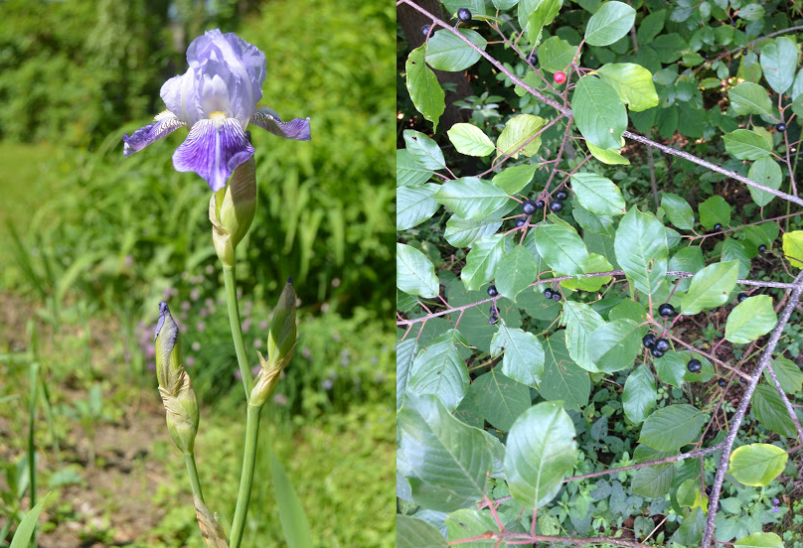
Iris flower and buckthorn berries
Iris flower and buckthorn berries. Photo by Adrienne d’Evreus.

Tuesday, March 22, 2016

Buckthorn berries, Yellow Experiment(s) 2

I tried to begin to follow another source to produce yellow.  I was working from Merrifield's Bolognese Manuscript, De Fiendis Viridibus again!  This book is so big, I'll never run out of possibilities. :D I will, ultimately, have to read it cover to cover.  I know I'm missing her details about general color production, opinions and her references.


Merrifield pg 428
The last ripe berries from Shana's New Hampshire Buckthorn bushes, about 30g, only yielded about 20 drops of juice so that attempt was unsuccessful.  At the end of September I found Buckthorn across the street in Saco.  I acquired the appropriate permission and went picking berries.  Someday I need to find an identification key for these Rhamnus spp bushes.  These berries seem plumper and larger, it must be a different variety or maybe they're just really ripe?
The 189g of big, juicy berries were manually squished with gloved hands and squeezed through cheesecloth to yield about 63g sludgy juice that I closed in a jar.
With fall archery events we were busy for more than the next month.  The juice sat closed in the jar for almost five weeks.  That was longer than the instructions indicated but I'm a volunteer... busy with being an archery safety officer and regular life activities when I'm not doing scribal or other Arts&Sciences projects!
I noted that when I finally opened the jar that the juice was definitely fermented and smelled like wine.
Athena Thickstun's blog helped me define that a 'fiasco' of wine is 2 liters.  One quarter of that would be 500g.  I didn't need that much so I made a smaller batch. Taking 200g distilled water I added a teaspoon of lye, K2CO3 (<1g on the kitchen scale that I had access to since I flooded the little one I had been using).  Then I added about the same quantity of alum (aluminum sulfate Al2(SO4)3. which resulted in immediate fizzling.  [I have since found out that that is the wrong alum.  Next time I will use rock alum which I have learned is KAl(SO4)2.]  As instructed I heated it in my corning ware sauce pot on low for the time that it took me to recite the Our Father prayer in Latin:
Pater noster qui es in coelis sanctificetur nomen tuum.
Adveniat regnum tuum. Fiat voluntas tua sicut in coela et in terra.
Panem nostrum quotidianum da nobis hodie.
Et dimitte nobis debita nostra, sicut et nos demittimus debitoribus nostris.
Et ne nos inducas in temptationem.
Sed libera nos a malo.
Amen.
Adding the prepared lye/alum/water to the jar of juice there was an immediate color change of the reddish juice to a yellow/green liquid.

"Very fine white earth like the fellmongers use" is defined in Alexander's glossary in the Dover edition of Merrifield's treatises as lime.

In the spring of 2016 I was able to come back to this experiment.

I found pulverized (vs. pelletized) lime at one of the big box garden centers.


Speaking to Randy Asplund about it again he advised that I was basically making a lake pigment and elaborated on the volume of a mezetta, "In Florence the mezzetta was equal to 0.7613 liters."  I recalled that I had made a smaller volume and not very accurately measured the lye and water in the fall because my little scale had died the quick death of drowning in a different experiment.  Water under the bridge; I'll know the correct mezzetta volume next time!  Regardless, this might have worked anyway.

Back to creating a lake pigment... Cool!  I have never made a lake.  The Materials and Techniques of medieval painting talks about brazil lakes:
Sometimes the decoction of brazil wood with alum was precipitated with chalk, and a more opaque, pink, rose colour was produced by the resulting admixture of calcium sulphate to the alumina lake.  Sometimes, in England, instead of adding chalk to the solution, a chalk stone was hollowed out, and little holes were made in the bottom of the hollow, and the hot alum solution coloured with brazil was poured into the hollow of the chalk.  The reaction between the alum and the chalk took place at the surface of the chalk stone, in that case, and a crust of semi-opaque brazil lake was formed in the hollow and in the little holes.
When lakes were made by precipitating the alum solution with the chalk, the calcium sulphate was formed automatically along with the lake, in intimate combination with it.  Sometimes brazil lakes were given some opacity by adding opaque substances to them at the moment of precipitation, and even after.  When white lead was used, as it sometimes was, it had no other effect than to give a little substance to the lake, to make it a little less transparent, and to develop the rosy colour.  when marble dust and powdered egg shells were added to the newly formed lakes, or introduced along with the precipitating agent, they probably had the further effect of controlling the colour produced by reacting chemically with any excess of alum which might give a brown cast instead of the desired rose.  In all these cases the brazil colour was mordanted upon the white material, whether calcium sulphate, or an excess of chalk, or white lead, or marble dust, or powered egg shells.  The white substances were, so to speak, dyed with the brazil; and the pigment so formed was different from a mixture of a finished lake with the white pigment. (Thompson 119)
So, since I'm making a lake, I tried both crushed eggshell and pulverized lime.  I took about 10 g of each and pipetted off about 5 g of liquid from the jar into each material.  The eggshell is probably not pulverized enough to paint with.  I wonder if I can mull it or crush it down and use it anyway.  And just maybe add more of the buckthorn/aluminum sulfate/lye juice after "in order that it may become more beautiful and of a brighter colour" (Merrifield 428)

Buckthorn yellow.  Ripe buckthorn berry juice with lye and aluminum sulfate with crushed eggshell.

Buckthorn yellow.  Ripe buckthorn berry juice with lye and aluminum sulfate with pulverized lime.
This experiment produced beautiful yellows!  Some day I'll try to paint with them.  I bet you can paint with the plain juice like with the sap green as a transparent glaze.  I wonder if you can make a green lake with that juice with lime or eggshells too.  Anyway, yay yellow!

Mr. Asplund advises that this yellow lake can be produced in the same way from green berries too.  Awesome!

Friday, March 18, 2016

Dyeing skins green with Buckthorn berries, ripe berries Experiment 3

I was excited to try dyeing some leather green using another recipe from one of Mary Merrifield's translated Original Treatises.  "Someday", I secretly dreamed, "Mistress Isabel Chamberlaine might make my wish a reality and take me as an apprentice.  I'll need a green belt!"  Spoiler alert... I was apprenticed at Birka!

Adrienne's Experiment steps:
Research
Collect materials
SAFETY FIRST... 
 Suit up with nitrile gloves, goggles over glasses and dust mask!

Back to the medieval inspiration for the dream for the need of a green belt...

Bolognese MS De Tintis ad Tigendum Pellum (Merrifield 558)
I wasn't sure what a medieval "boiler" was.  Not wanting to contaminate any of my food-grade cast iron pots, I used the same corning ware sauce pan as in Experiment 2.  I used another 100g of the ripe buckthorn berries from Shana's.  They had a few leafy bits but I wasn't willing to arduously pick that out and I didn't want to contaminate my berries by rinsing them.

Combining the ripe berries with the same quantity, by weight, of organic, unfiltered cider vinegar (Bragg brand) I continued to follow the instructions.  I put it on the simmer burner of my gas stove on low for fourty-one minutes.  When the berries and vinegar had "boiled a little" I took it off the heat.  I let it cool a bit then poured it into a washed, secured square of linen over a clean jar then squeezed the juice out into the sealable glass jar.

When I tried to paint it, the shinier 'outside' part of my leather just achieved a blueish gloss and the sueded part still blueish.  Maybe it's just because it's a modernly prepared piece of leather?  

Painting the first three experiments out on a small piece of leather, the only one that's green is Experiment 2.


I painted them out again onto what turned out to be chromium tanned moose leather six months later with pretty much the same results.

                                              Left 3/18/16                Right 9/15/15
                                         Experiment 1                   Experiments 3,2 and 1  
                                         Experiment 3
                                         Experiment 2

Tomorrow I'll try again on Vegetable tanned leather from Birka.

Thursday, March 17, 2016

Sap Green 2 from Buckthorn berries

This is the continuation of my research on trying the medieval paint recipes for Sap Green from Buckthorn.

Once I figured out what Buckthorn berry bushes looked like I began to see them everywhere.  Consequence?  More experiments!

I visited my good friend Shana Clark in New Hampshire to raid her local Buckthorn bushes in early September.  They were growing in a more open area in more sun than the ones in the first experiment.  The branches were full of berries, mostly ripe and dark and with a few green.  The next day I sorted them into 53g of green and 341g of ripe berries.

I had already experimented with the Iris Green paint recipe from De Arte Illuminandi with pretty results so I was excited to put the recommendations for Buckthorn to use.

De Arte Illuminandi, pg 7
And it's note: 

De Arte Illuminandi (Thompson and Hamilton 43)

Then the recipe:
De Arte Illuminandi (Thompson and Hamilton 7)
Adrienne's Experiment steps:
Research
Collect materials
SAFETY FIRST...
Suit up with nitrile gloves, goggles over glasses and dust mask!

I took 100.00g of ripe buckthorn berries and crushed them with a plastic fork.

In a glazed porcelain (corningware) sauce pan I mixed 11.60g of lye (K2CO3) with about 100g distilled water.  Adding 5.05g of alum (aluminum sulfate) resulted in immediate bubbling.  The reactions at this point have raised the temperature a little to 80F.  Warming the mixture on a simmer burner on low, I hoped to dissolve more of the alum.  After about ten minutes the bubbling had mostly stopped, the temperature had risen to 120F and the solution had a pH of 6 with a milky appearance.  After heating it up to encourage the alum to dissolve and losing a little in the sink when I poured it into the jar with crushed berries, the total weight of the solution had decreased to 87.07g.  There was also a little residue left in the pan.

I mixed the solution into the berries with the same plastic fork I had used to crush them.  The next day I found the solution bubbling out of my pint jar!  I got rid of the beautifully green paper towel beneath my jar and put it in a glass bowl.  As the recipe directs I "let them stand so, out of the way, for three days".  After they had rested I used a clean square of linen to strain the juice into another jar.

The next week I painted it out!  What a beautiful green!


Tuesday, March 15, 2016

Sap Green 1 from Buckthorn berries, medieval paint recipes,

There are many medieval sources with recipes for Sap Green, the beautiful paint and pigment used to provide green in medieval miniatures and to dye skins green among other things.

My first Experiment to produce green with Buckthorn was one from Mary Merrifield's Original Treatises, a 15th century recipe from Bolognese MS De Fiendis Veridibus (Merrifield 426)

I picked the berries in August in Westbrook, Maine.  Here's that first recipe:
Mary Merrifield's Original Treatises pg. 426
As the recipe suggests the day after picking the berries I combined about fifty grams each of ripe berries and Hannaford white vinegar of 5% acidity in a glazed sauce pan and heated it at gas mark two on the simmer burner of my stove.  At two minutes I noted that it was steaming, at four forming bubbles.  Five minutes in it was spattering so I turned it down to low and simmered until the weight of the mixture had reduced by about half which took about thirty-five minutes.  I poured it all into a square of washed clean linen secured over a canning funnel over a glass jar then squeezed as much liquid as I could into the jar.  The liquid looked dark purple.  Several days later I painted it out.

The alum water I used in the following paints is pure alum, Aluminum Sulfate, Al2(SO4)3, and distilled water in a 1:10 ratio.  This should make an acidic solution.

"A" consisted of a drop of the buckthorn and white vinegar juice as well as Winsor Newton Gum Arabic.  It painted out blue then turned green the next day.
"B" a drop of the vinegar-buckthorn berry juice, one drop of the gum water and a drop of alum water.  It painted out green immediately.

A on the left, B on the right.  Still wet B is already green.

"C" is the same as A in a clam shell, it painted out red purple-y and turned green by the next day.


"D" is C, juice and gum in a clam shell, with a drop of the same 1:10 alum water in B and like B it painted out green and stayed green.


Ultimately there will be an updated picture of after all of them turned green and one of my notes too!

And more experiments:
Experiment 2


Sunday, March 13, 2016

Sap Green and yellow from Buckthorn berries


Several important books talk about Sap Green, a medieval and renaissance pigment used in Book illumination among other things.  This year I had a mission to make some of this paint using the techniques and methods medieval paint makers may have utilized.

First I made note of all the different recipes for sap green and then had to find the materials these paint makers talk about.  

In De Arte Illuminandi, an anonymous 14th century treatise, translated from the Latin by Daniel Varney Thompson, Jr. and George Heard Hamilton in 1933, the author talks about several greens including buckthorn berries. (Thompson and Hamilton, pg 6-7)  

Buckthorn Berries are further described by the translators in their note "For the identification of these prugnameroli as buckthorn berries (Buckthorn = It. spincervino, spino gerbino), fruits of the varieties of buckthorn, Rhamnus, see Cennino ed. cit., II, p 32, n 1. (Thompson and Hamilton p 43). 

Further reading of this note explains the etymology of Sap Green which has nothing to do with the juice or sap from the plant and berries but how it may have been stored. 
"the color known in English as 'Sap Green,' the Italian verde di vescica (so called because the inspissated juice was preserved in bladders), the Saffgrien of Valentine Boltz, who specifies ed. cit., pg 75" the time of year "therefore, in Alsace, the color came out yellow if the berries were gathered in August, and green if they were gathered about the middle of September, we may probably assume that the quality of green yielded by these Rhamnus fruits was not entirely definite." De Arte Illuminandi pg. 29

So, Sap Green and yellow from the Buckthorn...

It took me what felt like forever to find Rhamnus spp. berries.  I searched the fields and ditches nearby, went to "Buckthorn Lane" in my local neighborhood in Saco, Maine; I found other trees with other fruits but no Buckthorn!  Finally someone said 'look for tall trees, usually somewhere wet' so I went back to my stomping grounds as a teenager in Wesbrook, Maine and found spindly trees in what used to be a protected wetland for turtles.  "This?!  Is this it?!" I begged my friends to confirm cell phone pictures of my find.  


The leaves look right from the plant books, the berries are dark and the bush was spindly and taller than I might have guessed, growing somewhere wet.  "Yes!", they chorused, "that looks right, try it!"

So I tried some of the recipes and will post them soon.  Sorry it's taken so long!

Sunday, September 13, 2015

Buckthorn Yellow from green buckthorn berries. a Paduan MS recipe.

Most students of the history of medieval and renaissance paint are familiar with Sap Green, often produced from ripe buckthorn berries. Fewer have experimented with a yellow pigment that can be made using the unripe green buckthorn berries. In Mary Merrifield's book Original Treatises a recipe from the Paduan Manuscript (662) explains how it's done!  Merrifield thinks that the Paduan Manuscript dates from the late 16th or more probably the mid or late 17th century (643).